
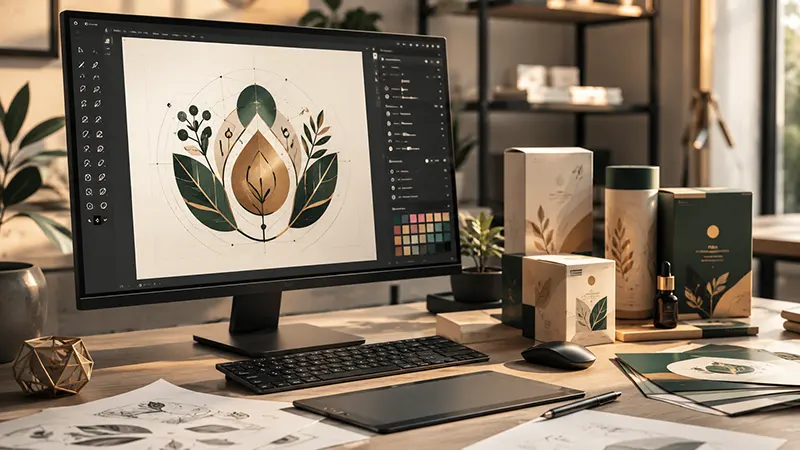
The creative industry transforms with using Artificial intelligence, and one of its most exciting innovations is the emergence of text-to-vector AI engines. Unlike traditional AI image generators that produce raster graphics, text-to-vector technology creates scalable vector artwork directly from written prompts. These vectors can be resized infinitely without losing quality, making them ideal for professional branding, logo creation, packaging design, marketing materials, and print production.
For designers, agencies, entrepreneurs, and packaging professionals, AI-powered vector generation significantly accelerates the creative workflow while reducing production costs. Instead of spending hours manually drawing icons, illustrations, or decorative graphics, designers can now generate editable vector assets in minutes and refine them using their preferred design software.
This article explores how scalable text-to-vector AI engines are reshaping professional packaging and branding design, the features that matter most, and the best practices for producing commercial-quality visual assets.
The Evolution of AI Design Tools
Artificial intelligence has rapidly evolved from simple image generation to highly specialized creative applications. Early AI tools focused primarily on producing bitmap images suitable for digital viewing. While impressive, raster images often lacked the scalability required for commercial printing and branding.
Text-to-vector AI engines solve this limitation by generating artwork based on mathematical paths rather than pixels. This enables designers to edit individual shapes, colors, curves, and layers while preserving image quality at any size.
For businesses that require logos, packaging illustrations, product labels, signage, and promotional graphics, vector output is a major advantage.
Why Vector Graphics Matter in Branding
Professional branding depends heavily on consistency. A company logo must appear equally sharp on a business card, billboard, website, product box, or vehicle wrap.
Vector graphics offer several important benefits:
Infinite Scalability
Unlike raster images, vector artwork can be enlarged without becoming blurry or pixelated. This makes it suitable for everything from social media icons to large-format printing.
Easy Editing
Designers can modify colors, shapes, outlines, gradients, and typography independently, making brand updates much easier over time.
Smaller File Sizes
Many vector formats are lightweight and efficient, allowing faster sharing and easier integration into design workflows.
Print-Ready Quality
Professional printers often prefer vector files because they preserve precision and deliver crisp output on packaging, labels, and promotional materials.
These advantages make vector graphics the industry standard for branding assets.
How Text-to-Vector AI Works
Text-to-vector AI engines combine natural language processing with machine learning models trained on vast collections of illustrations, symbols, icons, and graphic design elements.
Users simply describe the desired artwork using written prompts such as:
- Minimalist coffee logo with mountain silhouette
- Luxury perfume packaging illustration with floral accents
- Vintage botanical vector for cosmetic branding
- Geometric abstract pattern for premium packaging
The AI interprets these instructions and generates editable vector artwork that can be refined further if needed.
This process dramatically shortens concept development while providing designers with multiple creative starting points.
Applications in Packaging Design
Packaging serves as both protection and marketing. Attractive packaging helps products stand out on store shelves while reinforcing brand identity.
Text-to-vector AI engines can assist with creating:
- Product illustrations
- Decorative borders
- Pattern designs
- Packaging icons
- Sustainability symbols
- Ingredient graphics
- Infographics
- Brand mascots
- Floral decorations
- Minimalist geometric elements
These assets can be customized to match different product categories, from food and beverages to cosmetics and electronics.
Enhancing Brand Identity
Strong branding depends on visual consistency across all customer touchpoints.
AI-generated vector assets can be used throughout a brand ecosystem, including:
- Logos
- Business cards
- Letterheads
- Product labels
- Social media graphics
- Website illustrations
- Exhibition displays
- Packaging inserts
- Brochures
- Advertising campaigns
Using scalable vector assets ensures every design maintains a professional appearance regardless of size or medium.
Essential Features of Modern Text-to-Vector AI Engines
When evaluating AI-powered vector software, several capabilities are particularly valuable.
Editable Paths
Designers should be able to adjust anchor points, curves, and individual shapes after generation.
Layer Organization
Well-structured layers make complex illustrations easier to edit and prepare for production.
Color Control
Professional branding often requires strict adherence to brand color palettes. AI-generated vectors should support editable fills, gradients, and strokes.
Style Variety
Modern AI engines can produce artwork in a wide range of styles, including:
- Flat illustration
- Minimalist
- Line art
- Hand-drawn
- Geometric
- Isometric
- Vintage
- Luxury
- Organic
- Abstract
This versatility supports different industries and branding strategies.
AI Improves Creative Efficiency
One of the greatest advantages of text-to-vector AI is speed.
Instead of spending hours sketching concepts, designers can generate multiple ideas within minutes, allowing more time for refinement and client collaboration.
This accelerated workflow benefits:
- Creative agencies
- Freelance designers
- Marketing departments
- Packaging manufacturers
- Startup founders
- E-commerce businesses
Rapid concept generation also makes it easier to explore alternative visual directions before committing to a final design.
Supporting Sustainable Design Workflows
Efficient design processes can contribute to sustainability by reducing unnecessary revisions, minimizing material waste during prototyping, and streamlining production.
AI-generated vector assets enable designers to test multiple packaging concepts digitally before printing physical samples. This reduces ink, paper, and production costs while supporting environmentally conscious design practices.
Maintaining Brand Consistency
Although AI generates the initial artwork, human designers remain essential for maintaining visual consistency.
Professionals should ensure that generated assets align with:
- Brand guidelines
- Typography standards
- Color palettes
- Visual hierarchy
- Packaging regulations
- Printing requirements
AI works best as a creative assistant rather than a replacement for strategic design thinking.
Integration with Professional Design Software
Modern vector AI engines typically export files compatible with industry-standard design applications.
Common formats include:
- SVG
- AI-compatible vectors
- EPS
- Editable vector layers
These formats integrate seamlessly into existing packaging and branding workflows, allowing designers to refine AI-generated artwork using familiar tools.
Best Practices for AI-Generated Branding Assets
To achieve professional-quality results, designers should follow several best practices:
- Write clear and descriptive prompts.
- Generate multiple design variations.
- Refine vector paths manually when needed.
- Maintain consistent brand colors.
- Simplify overly complex illustrations.
- Test designs at different sizes.
- Ensure print compatibility.
- Review artwork for originality and accuracy.
- Balance AI efficiency with human creativity.
These steps help transform AI-generated concepts into polished commercial assets.
The Future of Text-to-Vector AI
Artificial intelligence is expected to play an even greater role in branding and packaging design. Future platforms will likely offer deeper customization, improved understanding of brand guidelines, real-time collaboration, and seamless integration with design ecosystems.
Advancements in generative AI may also enable dynamic packaging concepts, personalized branding assets, and intelligent design systems that automatically adapt visuals for different products, markets, and audiences.
Rather than replacing designers, these technologies will empower creative professionals to focus more on strategy, storytelling, and innovation while automating repetitive production tasks.
Scalable text-to-vector AI engines are redefining the way professional branding and packaging assets are created. By transforming written prompts into editable, high-quality vector graphics, these tools accelerate concept development while maintaining the scalability and precision required for commercial design.
Whether producing logos, packaging illustrations, decorative patterns, or marketing visuals, AI-powered vector generation offers businesses a faster and more flexible approach to creative production. Combined with human expertise in branding strategy and visual communication, text-to-vector AI represents a powerful solution for delivering consistent, professional-quality design assets in today’s competitive marketplace.

