
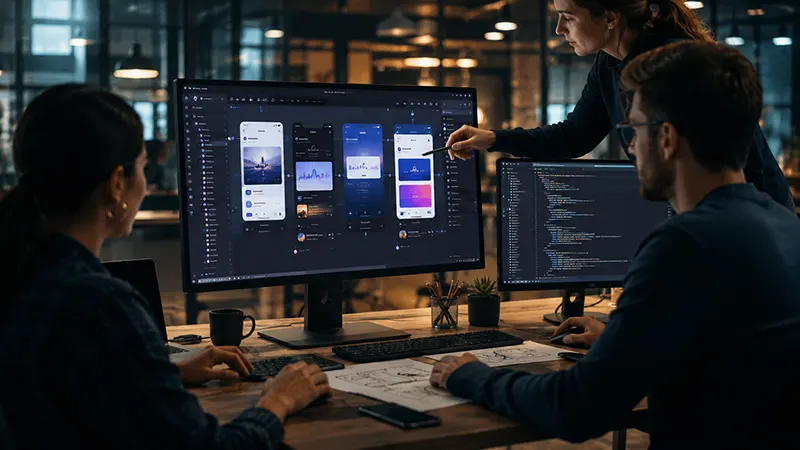
The digital product design process has evolved dramatically over the last decade. What was once a linear workflow involving designers, developers, project managers, and stakeholders has become a highly collaborative environment where multiple team members work simultaneously on the same project. Today, organizations prioritize speed, consistency, and seamless communication to deliver high-quality digital experiences across websites, mobile applications, SaaS platforms, and enterprise software.
One of the most significant innovations supporting this transformation is the rise of real-time collaborative graphic design platforms with automated developer code handoff. These modern platforms bridge the gap between design and development by allowing teams to collaborate in real time while automatically generating development-ready assets, style specifications, and front-end code snippets. The result is a faster, more efficient workflow that minimizes errors and accelerates product delivery.
The Evolution of Collaborative Design
Traditional design workflows often involved creating static mockups, exporting image files, emailing revisions, and manually documenting design specifications for developers. This process was time-consuming and frequently introduced inconsistencies between the approved design and the final implementation.
Modern collaborative platforms replace these disconnected steps with cloud-based workspaces where designers, developers, marketers, and project managers work together using a shared source of truth. Every design update becomes immediately available to team members, reducing delays and improving communication throughout the product lifecycle.
Why Real-Time Collaboration Matters
As businesses increasingly rely on distributed teams and remote work, real-time collaboration has become essential. Team members may work from different cities or countries, making cloud-based collaboration the most practical solution.
Real-time collaboration provides several advantages:
- Multiple designers can edit the same project simultaneously.
- Stakeholders can review designs without downloading files.
- Comments and feedback appear instantly.
- Version history protects previous iterations.
- Team members always access the latest design.
These capabilities reduce confusion while keeping projects moving efficiently.
A Unified Workspace for Designers and Developers
One of the greatest challenges in digital product development is maintaining alignment between design and implementation.
Modern collaborative platforms provide a centralized workspace where:
- UI designers build layouts.
- UX designers test user flows.
- Developers inspect design properties.
- Product managers monitor progress.
- Marketing teams review branding consistency.
- Clients provide approvals.
Instead of switching between multiple applications, everyone collaborates within a shared environment.
Automated Developer Code Handoff
Perhaps the most valuable feature of modern design platforms is automated developer handoff.
Rather than manually documenting design specifications, the platform automatically generates development-ready information such as:
- CSS properties
- Typography settings
- Color variables
- Spacing values
- Border radius
- Shadow effects
- SVG assets
- Image exports
- Responsive measurements
Developers can inspect interface elements directly and retrieve the exact values needed for implementation.
This significantly reduces misunderstandings between design and development teams.
Design Systems Improve Consistency
Professional digital products rely on reusable components rather than designing every screen individually.
Collaborative platforms support comprehensive design systems containing:
- Buttons
- Icons
- Navigation menus
- Cards
- Form controls
- Color palettes
- Typography libraries
- Grid systems
- Spacing rules
Whenever a component changes, every instance updates automatically throughout the project, ensuring visual consistency.
Responsive Design Made Easier
Modern applications must function across multiple devices and screen sizes.
Collaborative platforms often include responsive layout tools that help designers visualize how interfaces adapt to:
- Smartphones
- Tablets
- Laptops
- Desktop monitors
- Ultra-wide displays
Developers receive responsive specifications directly from the design, reducing implementation errors.
Interactive Prototypes Without Coding
Static mockups rarely communicate the complete user experience.
Today’s collaborative platforms allow teams to build interactive prototypes featuring:
- Clickable navigation
- Animated transitions
- Screen interactions
- Hover states
- Loading animations
- User flows
These prototypes help stakeholders understand how the final product will behave before development begins.
Built-In Version Control
Creative projects naturally evolve through multiple revisions.
Version history enables teams to:
- Restore previous designs
- Compare iterations
- Track contributor changes
- Experiment safely
- Document project milestones
This functionality eliminates concerns about accidentally overwriting important work.
Instant Feedback Speeds Decision-Making
Traditional review processes often rely on lengthy email chains.
Real-time commenting simplifies communication by allowing reviewers to:
- Pin comments directly to design elements.
- Suggest revisions.
- Approve completed sections.
- Assign tasks.
- Resolve discussions.
Keeping feedback within the design file creates a clear audit trail and accelerates decision-making.
Asset Management Across Teams
Large organizations frequently manage thousands of design assets.
Collaborative platforms typically include centralized libraries for:
- Logos
- Brand illustrations
- Icons
- Images
- UI components
- Marketing graphics
- Product screenshots
- Color tokens
Centralized asset management ensures that every team member works with approved resources.
AI Enhances Productivity
Artificial intelligence is becoming an integral part of collaborative design platforms.
AI-powered capabilities can assist with:
- Generating layouts
- Suggesting color combinations
- Creating icons
- Producing illustrations
- Writing placeholder content
- Improving accessibility
- Organizing design components
- Recommending spacing adjustments
These features automate repetitive tasks while allowing designers to focus on creativity and user experience.
Security and Access Control
Enterprise organizations require secure collaboration environments.
Modern platforms provide:
- User authentication
- Role-based permissions
- Secure cloud storage
- Activity tracking
- Encrypted collaboration
- Team administration
- Audit logs
These features protect intellectual property while enabling efficient teamwork.
Benefits for Development Teams
Developers gain significant advantages through automated code handoff.
Instead of manually measuring interface elements or recreating colors, they can instantly access:
- Pixel-perfect spacing
- Font specifications
- Exportable SVG graphics
- Responsive measurements
- Color codes
- Component documentation
This reduces development time while improving implementation accuracy.
Faster Product Delivery
Collaboration and automation reduce delays throughout the product development cycle.
Organizations benefit through:
- Shorter design iterations
- Faster approvals
- Reduced communication overhead
- Fewer implementation errors
- Improved quality assurance
- More predictable project timelines
These efficiencies help companies deliver digital products more quickly without sacrificing quality.
Best Practices for Collaborative Design
To maximize the value of collaborative platforms, teams should:
- Establish a shared design system.
- Organize projects consistently.
- Use reusable components whenever possible.
- Keep naming conventions clear.
- Review version history regularly.
- Encourage continuous communication.
- Validate responsive layouts early.
- Test interactive prototypes before development.
Following these practices improves both collaboration and long-term project maintainability.
The Future of Collaborative Design Platforms
The future of collaborative graphic design will be increasingly driven by artificial intelligence, automation, and cloud-native workflows. AI will continue to assist with design generation, accessibility improvements, component management, and predictive user experience optimization. Automated developer handoff will become even more sophisticated, generating cleaner front-end code and supporting multiple frameworks simultaneously.
As remote work continues to grow, organizations will rely even more heavily on collaborative platforms that integrate design, prototyping, documentation, project management, and development into a single connected ecosystem.
Closing
In , real-time collaborative graphic design platforms with automated developer code handoff have fundamentally changed how modern digital products are created. By bringing designers, developers, stakeholders, and project managers together within a shared workspace, these platforms eliminate communication barriers while improving efficiency, consistency, and design quality.
Features such as live collaboration, reusable design systems, responsive layouts, interactive prototypes, centralized asset management, AI-powered assistance, and automated code generation enable organizations to streamline workflows and accelerate product delivery. As technology continues to evolve, these collaborative ecosystems will remain at the center of modern UX, UI, branding, and software development, empowering teams to build exceptional digital experiences faster than ever before.

