
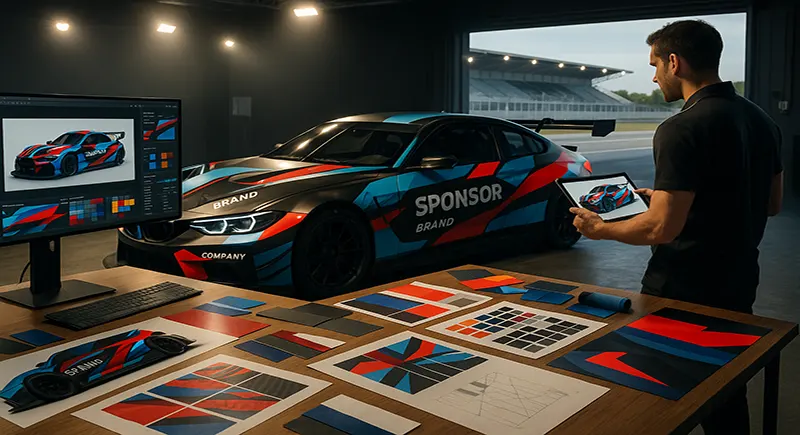
A racing car livery is far more than just a paint job; it is a meticulously crafted, high-speed corporate identity. For motorsport teams, the racing car livery design is a critical asset that functions as a mobile, high-exposure advertisement, a visual statement of brand identity, and a functional tool for sponsor retention. The best liveries are those that master the delicate balance between aesthetic appeal and strategic communication.
1. The Livery as a Marketing and Sponsor Asset
The core function of any professional race car livery is to maximize brand visibility for sponsors. This requires a strong design hierarchy.
- Sponsor Placement & Hierarchy: The designer’s first task is to translate sponsorship tiers into visual real estate. Primary sponsors must dominate key, easily viewable areas (like the sidepods, engine cover, or front wing endplates) with their logos rendered in the largest, most visually dominant size. Secondary and tertiary sponsors are strategically placed in less prominent, but still visible, locations.
- Vector Fidelity: A professional designer ensures all sponsor logos are supplied and utilized as vector graphics. This guarantees that the logo can be scaled to the massive dimensions of a race car without any loss of quality or pixelation, which is crucial for high-resolution media coverage and large-format printing.
- Brand Guidelines: Strict adherence to multiple brand guidelines (the team’s, the major sponsors’, and the series’ official logos) is paramount. The designer acts as a mediator, ensuring all elements coexist harmoniously without clashing colors or violating corporate identity rules.
2. Design for Speed and Visibility
A livery must be designed to be legible at over 200 mph and instantly recognizable from a distance or on a television screen.
- The 3D Challenge: Unlike print design, a car is a complex 3D shape with compound curves. Designers use precise 2D car templates to map out graphics, anticipating where the vinyl will stretch, curve, or break across body panels and ensuring key graphics don’t become distorted or illegible across vents, door handles, or aerodynamic elements.
- High Contrast and Simplicity: The most iconic liveries—like Gulf’s light blue and orange or JPS’s black and gold—succeed due to their simplicity and high contrast. Designers utilize a limited color palette that makes the car instantly distinguishable on track and ensures sponsor logos “pop” against the base color.
- Numbering and Typography: Race numbers and driver names must comply with strict series regulations regarding size, font weight, and background requirements. The typography chosen for the car’s title or team name must convey the team’s spirit—aggressive for rally cars, sophisticated for endurance racers.
3. The End-to-End Process
Professional livery design services go beyond the initial concept, providing comprehensive support to the team and the installation crew.
- 3D Visualization: High-quality 3D renders are essential. They allow the team, sponsors, and stakeholders to visualize the design from every angle before the vinyl is cut, preventing costly changes and ensuring the sponsor exposure sold matches the final reality.
- Print-Ready Files: The final delivery is not just an image, but a perfectly scaled, layered wrap file (often AI or PDF) with bleed and panel overlaps clearly marked, ready for the vinyl printer and installer, creating a seamless transition from concept to the racetrack.
A well-designed racing car livery is a non-negotiable component of a modern motorsport team’s success, blending high art with precision engineering to create a brand that dominates both the track and the screen.

